



His Excellency,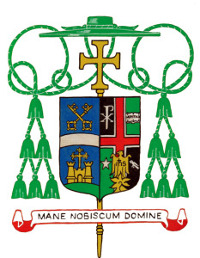
The Most Reverend Edward K. Braxton, Ph.D., S.T.D.
Diocese of Belleville
Sermon:
The Solemnity of the Ascension of the Lord,
May 15, 2021,
Blessed Sacrament Parish, Belleville
“Why Are You Standing There Looking Up?”
(This is the text as originally written. During the actual delivery, some passages were omitted and other comments were added spontaneously. Nota bene: This text has not been thoroughly proofread. Therefore, there may be errors in spelling, grammar and punctuation.)
Dear Sisters and Brothers in Christ:
Where did He go? This is the first question young children ask me when I tell them about the mystery of the Ascension of the Lord, which we celebrate today. When He was lifted up into the clouds, where did He go? Because of the imagery in scripture, the children think, Jesus must have been lifted up and carried through space to some distant place. The question “Where did He go?” is not easy to answer for children or for adults. If the risen Lord was not taken to some distant “place” in the universe when He was lifted up, where did He go? Obviously, He did not go to some physical place to which we could travel on the latest spacecraft. We must remember that at the time of Christ, people believed that the earth was like a flat table. The moon, the sun and the stars were above the table and above that was the realm of water, and above that, God and the angels dwelled. So, it was common to refer to God as living UP in Heaven! “He was lifted up” means that Jesus returned to the Father and the Holy Spirit, who sent Him. (Similarly, when the Gospel states that the ascended Lord “took His seat at the right hand of the Father,” this is not to be taken literally. He is being compared to a royal prince, the heir to his father’s throne, who sits at his father’s right side as one equal to his father in dignity and power.)
For the past seven weeks we have been meditating on Jesus’ death, resurrection, ascension, and his sending us the Holy Spirit. We began to celebrate this mystery during Holy Week, the Sundays of Easter, the mystery of the Ascension, which we celebrate today, and the coming of the Holy Spirit which we celebrate next week on Pentecost Sunday. In a very real sense the Resurrection of Jesus, the Ascension of Jesus, and Jesus sending His followers the gift of the Holy Spirit on Pentecost are all part of one dense three-fold mystery. If we really understand this three-fold mystery, we realize that the Resurrection, Ascension and Pentecost have a far greater religious significance than the birth of Jesus. This may be why the biblical account of the birth of Jesus, found only in Luke and Matthew, were written AFTER the rest of the gospels and added as a kind of prologue.
Luke tells us about the ascension in today’s reading from the Acts of the Apostles. “In the first book, Theophilus (a name which simply means “one who loves God”), I dealt with all that Jesus did and taught until the day he was taken up, after giving instructions through the Holy Spirit. He told the apostles not to leave Jerusalem, but to wait for “the promise of the Father.” “In a few days you will be baptized with the Holy Spirit. You will receive power when the Holy Spirit comes upon you, and you will be my witnesses in Jerusalem, and to the ends of the earth.” When He had said this, Jesus was lifted up, and a cloud took Him from their sight. Suddenly, two men dressed in white garments said, “Men of Galilee, why are you standing there looking up?” Notice just as there were men or angels in white garments at the empty tomb, so, at the moment of the Ascension, there are “men in white garments” who always symbolize the divine presence.
The ascended Christ remains with the Apostles, urging them to preach His Good News of salvation, peace, justice and reconciliation.
“Why are you standing there looking up?”
Jesus’ life, death, resurrection, ascension, and the sending of the Holy Spirit all take place in a tiny country, modern day Israel, which we call “The Holy Land.” Have you ever wondered why we call it the Holy Land? Is it simply because the life of Jesus, the greatest story ever told, unfolded there? That one remarkable life would certainly make it a Holy Land. But what if, what if, the power of the ascended Christ, the power of the Holy Spirit whom He sent, what if that power were actively present in the hearts and minds of the mainly Jewish and Arab Muslim people who live in Israel today? (As you know, in recent decades, the Palestinian Christian population in Israel has dwindled to a very small number.)
What if, even though they are NOT Christians, the power of the ascended Christ and the Holy Spirit could be unleashed in the minds and hearts of people engaged in a tragic, deadly unending war that is destabilizing the whole world? Would not that power bring greater holiness into the lives of all engaged in this titanic struggle? Would the increased holiness in their lives lead to the conversion of hearts and a grasp of Jesus’ command, “Love your neighbors as you love yourselves!?” Would this not make modern-day Israel a “Holy Land”?
As we celebrate the mystery of the Ascension, I would like to ask you to turn your attention away from images in church windows of Jesus going up into the clouds. Instead, turn your attention to the very earth, the very land from which He ascended and pray every day between now and the feast of Pentecost next Sunday for the Israelis and the Palestinians, that they may come to a fuller realization that they have a very real role to play in making their land a “Holy Land.”
“Why are you standing there looking up?”
Let me remind you of what is going on across the world in the strife torn Holy Land. It is not a pretty Easter card picture. It is a scene of constant violence, destruction, and death, yes, even the deaths of children.
The recent escalation of fighting between Israelis and Palestinians has led the United Nations to warn of a "full-scale war," with Hamas in Gaza bombarding Israel with rockets and with Israel retaliating by bombing Gaza. The latest violence followed a month of rising tensions in Jerusalem. President Biden and world leaders have called upon the warring factions to deescalate violence and embrace a cease-fire. So far, this has not happened.
This conflict has gone on for decades. Britain took control of the area known as Palestine after World War I. At the time, the land was inhabited by a Jewish minority and an Arab majority. Tensions between the two peoples grew when the international community gave Britain the task of establishing a "national home" in Palestine for the Jewish people. Many Jewish people considered it their God-given ancestral home, going back to Moses and the Exodus. Palestinian Arabs also claimed the land as rightfully theirs.
In 1947, the United Nations voted for Palestine to be split into separate Jewish and Arab states, with Jerusalem becoming an international city. That plan was accepted by Jewish leaders but rejected by the Arab side and never implemented. In 1948, unable to solve the problem, British rulers left and Jewish leaders declared the creation of the state of Israel. Most Palestinians objected and war followed. Troops from neighboring Arab countries invaded.
By the time the fighting ended in a ceasefire in 1948, Israel controlled most of the territory. Jerusalem was divided between Israeli forces in the West, and Jordanian forces in the East. Because there was never a peace agreement – each side blamed the other – there were more wars and fighting in the decades which followed.
After the 1967 war, Israel occupied East Jerusalem and the West Bank, as well as most of the Syrian Golan Heights, and Gaza and the Egyptian Sinai peninsula. Most Palestinian refugees and their descendants live in Gaza and the West Bank, as well as in neighboring Jordan, Syria and Lebanon. Neither they nor their descendants have been allowed by Israel to return to their homes. Israel argues this would overwhelm the country and threaten its existence as a Jewish state.
Israel claims the whole of Jerusalem as its capital, while the Palestinians claim East Jerusalem as the capital of a future Palestinian state. Most countries do not recognize Jerusalem as the capitol of Israel. In the past 50 years Israel has built numerous settlements in Arab areas. Now, more than 600,000 Jewish people live as settlers in Arab areas, making a two-state solution almost impossible.
Tensions are often high between Israel and Palestinians living in East Jerusalem, Gaza and the West Bank. Gaza is ruled by the Palestinian militant group called Hamas, which has fought Israel many times. Israel and Egypt tightly control Gaza's borders to stop weapons from getting to Hamas. Palestinians in Gaza and the West Bank say they are suffering because of Israeli actions and restrictions. Israel says it is only acting to protect itself from Palestinian violence.
Things have escalated since the start of the Muslim holy month of Ramadan in April, with nightly clashes between police and Palestinians. The threatened eviction of Palestinian families in East Jerusalem by Israel has intensified the conflict. Israel asserts that it has the right to defend itself against Palestinian rocket attacks. Palestinians assert that only a small number of Jewish people have been killed by their rockets. While large numbers of Palestinian Arabs have died from Jewish bombing. The Palestinians also argue that the United States is not an honest broker for peace since it favors Israel with billions of dollars per year for military defense.
Peace talks led by different American presidents have been going on for more than 25 years. Different versions of a two-state solution have been proposed again and again. The United Nations, the United States, and even the Vatican have attempted unsuccessfully to bring the two sides to reconciliation. However, the violent, bloody conflicts between these two peoples, in an area no larger than the state of New Jersey, seem to be intractable and absolutely unsolvable.
Dear Sisters and Brothers in Christ, at this point you may be thinking that the Bishop is giving us too much history and politics in his homily. After all, we are in Church. We are not here to learn about conflicts in far-away Israel. The Bishop should be focused more on helping us to grow in personal holiness by strengthening our belief in the mystery of the Resurrection, the Ascension and the coming of the Holy Spirit. He should not be telling us about the endless conflict between the Israelis and the Palestinians, which no one can solve.
It is certainly my intent to deepen and strengthen your Easter faith. But that Easter faith which brings us to the altar at Sunday Mass to receive the body and blood of Jesus Christ surely impels us to bring Christ out of the Church and into our daily lives. Our Christian faith and spirituality make it impossible for us to ignore the crisis in the Middle East. Surely you realize that we should have a burning desire to pray fervently that the truth of the Easter mysteries will have a real and peace-making impact upon nations and people in our world who in conflict, choosing violence, war, and deadly destruction over negotiation, diplomacy, and compromise. I hope this helps you to understand why it is difficult for me, on this Feast of the Ascension of the Lord, to be silent about the plight of what we call the Holy Land, tragically drenched in the blood of so many Jewish people and so many more Palestinian people.
Where did Jesus go when He ascended to the Father? What if, with the aid of our prayers, He ascended into the Holy Land, into the minds and hearts of the warring factions of the Palestinians and the Israelis? What if He is abiding there waiting to be nudged into action by your unending prayers?
“Why are you standing there looking up?”
Praise be Jesus Christ.
Both now and forever! AMEN!