



The Reverend Dr. Martin Luther King, Jr.:
What If He Was Still Alive Today?
(April 4, 1968-April 4, 2018, Fifty Years Later)
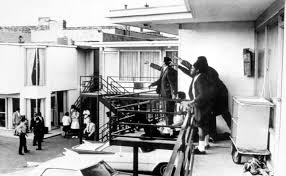
A mortally wounded Dr. King sprawled on the balcony of the Lorraine Motel as his aides point in the direction of the gunman.
"Everybody can be great, because everybody can serve. You don't have to have a college degree to serve. You don't have to make your subject and your verb agree to serve. You don't have to know about Plato and Aristotle to serve. You don't have to know Einstein's theory of relativity to serve. You don't have to know the second theory of thermodynamics in physics to serve. You only need a heart full of grace, a soul generated by love. And you can be that servant."
- Dr. Martin Luther King, Jr.
By
The Most Reverend Edward K. Braxton, Ph.D., S.T.D.
Bishop of Belleville
April 4, 2018
(This reflection is an exercise in imaginative thinking. Writing in this format allows the author to imagine possible points of view and thoughts. It does not intend to suggest, in any way, that these are actual thoughts or words of Dr. King. Hence the frequent use of phrases such as, “He might have said,” or “He might have thought.” Ultimately, the words and thoughts must necessarily be the author’s own, since Dr. King’s mighty voice has been silenced.)
I. Remembering That Terrible Day
(1) On Holy Thursday, April 11, 1968, Blessed Paul VI lamented the cruel and brutal murder of Dr. Martin Luther King, Jr. one week earlier on April 4. The Pontiff, noting that this heinous event was not unlike the Passion of Jesus Christ, lamented that the world must pray for the day when human beings no longer prey on one another like wolves.
(2) When I think of the violence, the hatred, and the evil that engulfed the balcony of the Lorraine Motel on that terrible day in Memphis, Tennessee, I do not think of the word “assassination.” That word is too clean, too detached, and too antiseptic to convey my vivid memories as a youthful seminarian. The image of Dr. King’s body sprawled on the balcony with a towel over the gaping hole in the side of his face and so much blood flowing from his wound made it obvious to me that he was dead. It was murder, murder most foul.
(3) Regretfully, I never had the privilege of hearing Dr. King speak in person. However, in 1966, he came to my hometown of Chicago, Illinois, two years before he was murdered. He came for the Chicago Freedom Movement, a Southern Christian Leadership Conference effort to bring the forces of the Civil Rights Movement to bear on the long-standing reality of the city’s education, housing and employment policies notorious for their systemic racial segregation and discrimination. During his visit, I read every article and watched ever television program I could. I was galvanized by his presence and his words.
(4) I was watching on August 5th when he led a march through an all-white neighborhood in an environment of intense racial hostility. He and the non-violent protesters were cursed at and spat upon as the crowd hurled bottles and bricks at them. When Dr. King was hit in the head with a brick, he said: ‘‘I have seen many demonstrations in the South but I have never seen anything so hostile and so hateful as I’ve seen here today.’’ In 1983, Dr. King’s assessment of the situation in Chicago was documented in Arnold R. Hirsch’s, “Making the Second Ghetto: Race and Housing in Chicago, 1940-1960.” Less than two years after Dr. King was assaulted, this Nobel Peace Prize laureate, this advocate of nonviolence and civil disobedience for the cause of justice, this troubadour for the end of racial discrimination, was dead.
(5) He was only 39 years old.
(6) I know that for some Americans and, yes, for some Catholics, his death means little more than a “day off” in January and today’s date will pass unnoticed. For many others, his death marked a critical turning point in American history. For my family and for me, April 4, 1968 was a day of emotional turmoil and immense sadness that remains vivid in my memory to this day.
II. His Eyes are Not Dimmed: Progress and Regression
(7) But, what if, what if Dr. King was still alive today? What if that gunshot wound had not been fatal and he had survived and lived through all of the events of the 1970s, 80s, 90s, to the dawn of the new millennium and on to this present day? What if Dr. Martin Luther King, at 89, was in our midst as one, like Moses, whose eyes were not dimmed, nor his natural forces abated (cf. Deuteronomy 34:7)?
(8) He would have enjoyed thirty eight more years with his wife, Coretta Scott King, until her death in 2006. He would have lived long enough to acknowledge the truth of whispered rumors of marital infidelity or to state definitively that they were untrue. He would also have witnessed the murder of presidential candidate, Senator Robert F. Kennedy on June 5, just two months and a day after his death. At times, Dr. King and the Senator had a tense relationship, but, ultimately, he had been a key influence on Senator Kennedy’s gradual realization of the grave moral and social crisis caused by the racial divide in America. He would have proudly attended the opening of the Smithsonian’s National Museum of African American History and Culture on the Mall that he made iconic with his “I have a Dream” speech.
(9) He would have been proud of his nine-year-old granddaughter, Yolanda Renee King, and her impressive presentation in Washington, DC, on March 24, 2018, at the March for Our Lives against gun violence initiated by students galvanized by the senseless gun murders at Marjory Stoneman Douglas High School. When Yolanda said, “I have a dream too; no more gun violence,” he might have sighed with relief since he once felt that his own life would be cut short by gun violence. He might have uttered a silent prayer of gratitude thinking back on that day in April 1968. Remembering how difficult it was at first for the Civil Rights Movement to get any coverage from the mainstream media, he would be impressed by the effective manner in which these students are making use of every means of social media. He might be even more impressed by the way the Black Lives Matter Movement has drawn attention to its concerns and its demonstrations via social media. He would certainly affirm with Congressman John Lewis that without the attention finally paid to the struggle by mainstream media, the Civil Rights Movement “would” have been like a bird without “wings.”
(10) On Easter Sunday, April 1, 2018, he might have sat down to Easter dinner with his children and his children’s children to enjoy an old-fashion southern dinner. After dinner, he might have watched the television presentation of the Andrew Lloyd Webber and Tim Rice rock opera, “Jesus Christ Superstar,” with the African-American singer, John Legend singing the role of the Christ. Whatever else he may have thought of the production, he would have been happy to see so much racial diversity in the cast. If someone had taken him to see Lin-Manuel Miranda’s “Hamilton,” he would have been equally pleased to see important historical figures (George Washington, Thomas Jefferson, Aaron Burr, and Hamilton himself) portrayed by African-Americans. He might have nudged the person next to him and said, “We would not have seen this in 1968.”
(11) The eighty-nine year old Dr. King, looking back fifty years at our country, would see both progress and regression. He would take note of the eight-year presidency of Barack Obama, the country’s first bi-racial president. He might have been quite surprised and encouraged by the fact that a youthful African-American senator from Illinois was elected and re-elected. He would surely appreciate the President’s efforts to reform healthcare laws for the benefit of the poor and uninsured. But, it is unlikely that he would be surprised that the Affordable Care Act was flawed and controversial. He would not be shocked to see that the President’s successor has attempted to dismantle the Affordable Care Act. Knowing the complexity of the racial divide, he would be quick to point out that those who thought President Obama’s time in office was the beginning of a post-racial America were quite naïve. If he had the chance to read Ta-Nehisi Coates’ “We Were Eight Years in Power,” he might well read some of the author’s more controversial statements with a critical eye.
(12) Considering the brevity of his time in national leadership (1956-1968), Dr. King gradually developed an ambitious agenda. By means of his speeches, writings, and non-violent demonstrations, he sought to bring about federal legislation to address social, racial and economic injustice. Only then could there be meaningful hope for reconciliation between the races and economic and social classes. (Eventually, he added his opposition to the War in Vietnam to this agenda.) If he was alive today, he would be particularly disappointed at the persistence of economic disparity and injustice.
(13) The Equality of Opportunity Project recently published an extensive study that examined racial differences in economic opportunities in a pool of 20 million children. The study examined them and their parents over several generations. The results clearly demonstrated that racial identity and racial prejudice continue to have a major influence on who does and does not make economic progress in this country. Sadly, African-American young boys almost always grow up to earn less than their white counterparts as adults. This is true even if they grow up in wealthy communities raised by wealthy parents. The Equality of Opportunity Project study concluded that African-American boys have consistently had much lower rates of upward mobility than their European-American counterparts. This has been a dominant factor shaping generations of racial income disparity. If Dr. King was to read Michael K. Honey’s “To the Promised Land: Martin Luther King and the Fight for Economic Justice” along with this study, and examine contemporary data on widespread discrimination against African-Americans in housing, employment and education, he might conclude that for every two steps forward there have been three steps backward. Indeed, if he read the 1968 report by the National Advisory Commission on Civil Disorders (The Kerner Report), and examined today’s data, he would see a return to segregated schools, an increase in poverty rates, and astonishing incarceration rate among African-Americans, due in part to sentencing policies that racially discriminate, with harsher sentences on crack users than on powder cocaine users.
(14) The drum major for justice and peace, who walked in the footsteps of Mahatma Gandhi working for non-violent conflict resolution, would surely grieve over the deaths of so many young African-American men in violent conflicts with white representatives of law enforcement. He would have seen the funeral on Holy Thursday in Sacramento, California for Stephon Clark, 22, an unarmed African-American man shot at twenty times by police on March 18, 2018. Mr. Clark was suspected of vandalism and thought to have a gun that turned out to be his mobile phone. Allegedly, he was not given sufficient time to raise his hands and medical help for him was not called immediately. Video and autopsy reports indicate that at least six fatal shots struck him in the back. Many community members asked for a federal investigation. However, a spokesperson for the White House said the shooting death was “a local matter.”
(15) Making use of technology that he would have lived to see had he not succumbed on that Memphis balcony, he would go online to find that in recent years, the list of African-Americans who have died in altercations with law enforcement is too long to count. These include: Terence Crutcher, Tulsa, OK; Philando Castile, Falcon Heights, MN; Samuel DuBose, Cincinnati, OH; Sandra Bland, Prairie View, TX; Freddie Gray, Baltimore, MD; Walter L. Scott, North Charleston, SC; Akai Gurley, Brooklyn, NY; Laquan McDonald, Chicago, IL; Keith Lamont Scott, Charlotte, NC; Paul O'Neal, Chicago, IL; Alton B. Sterling; Baton Rouge, LA; Christian Taylor, Arlington, TX; Tamir Rice, Cleveland, OH; Michael Brown, Jr., Ferguson, MO; Eric Garner, Staten Island, NY.
(16) A thoughtful man of prayer, not inclined to make hasty judgments, Dr. King would readily acknowledge that each of these cases is different with different circumstances and different individuals. He would acknowledge that police are sometimes in very difficult situations in which they must make split second decisions. They must act in an instant when they think their lives or the lives of others are in danger. He would acknowledge that some young African-American men break the law and others are dangerous criminals. Nevertheless, he would be deeply distressed by this litany. He would not be unaware of the fact that when Dylann Roof, a self-proclaimed white supremacist, slaughtered nine innocent African-Americans in Mother Emmanuel African Methodist Episcopal Church in Charleston, SC on June 17, 2015, he was arrested by the police without a shot being fired.
(17) He would be concerned about the widening gulf of suspicion between many People of Color and white law enforcement. He would be distressed by the fact that many in these communities believe strongly that at least some of these deaths could have been prevented by better police training, the use of Tasers or shooting to disarm and not to kill. He would argue that suspected wrong-doers should not be tried, convicted, and executed on the streets. He would understand the grief, even the rage in some communities, but he would certainly not condone the violent and destructive acts of civil disobedience that have sometimes followed these sad deaths. He might be somewhat encouraged by the efforts of police departments in some major cities to increase the number of African-American police and to work with African-American communities to establish better channels of communication and understanding. He might question the statement, “Most police shootings of African-Americans by police are legally justified.”
(18) Dr. King would be particularly stunned to see what has become of one of the greatest achievements of the Civil Rights Movement: the 1965 Voting Rights Act. The Supreme Court’s 2013 Shelby County v. Holder decision, led by Catholic Chief Justice John Roberts, argued that “things have changed dramatically” and it is no longer necessary for states with long histories of voting discrimination to get federal permission before changing their voting laws. He would point out that the Chief Justice’s words were disproved when Texas and North Carolina, both covered by the Voting Rights Act, passed new discriminatory voting laws just hours after the court’s ruling. He would concede that literacy tests and poll taxes are gone. But, he would challenge republican legislators who have recently enacted law which are roadblocks for African-American voters. Limiting early voting and same-day registration, voter-ID laws, closing polling places, and redistricting laws have been defended as racially neutral. But, Dr. King point to the obvious truth. These policies make it more difficult for People of Color to exercise their most basic rights as citizens, the right to vote. Justice delayed is justice denied.
III. Googling “Christianity in America: the Catholic Church”
(19) Utterly fascinated by Google, YouTube, the enormous capacity of mobile phones and all the forms of social media that did not exist and were not even thought of in 1968, it would be hard to keep Dr. King away from a computer. Since he saw equal opportunities for a good education for People of Color as the central goal of the Civil Rights Movement, he might hail the computer as the greatest educational device ever to be developed with a tremendous power for good, as well as for harm.
(20) If he Googled “Christianity in America,” he would see significant growth and strength in some Christian communities and in some parts of the country. He would see mega churches attracting thousands of worshipers on Sundays and providing a wide variety of family services that he would not have considered when he pastored Ebenezer Baptist Church in Atlanta. He would see an ecumenical movement in which Christian communities seem to have moved away from the hopes for actual structural Christian unity evoked by the Second Vatican Council just five years before he escaped death in Memphis to an emphasis on practical, grassroots ecumenism focusing on shared concerns to meet human needs, especially the needs of the poor and marginalized. At the same time, he would see a real polarization among Christians who identify as active in the Church. This polarization is often over moral issues such as abortion, homosexuality, the nature of marriage, gender identity, and euthanasia, and policy issues such as the role of the United States as a world leader, immigration reform, care for the environment, international conflicts, and gun control.
(21) Dr. King would not be blind to the fact that this polarization contributed to the tensions surrounding the 2016 presidential election and the raucous debates that have followed the election. As a political pragmatist, he would very likely have spoken forthrightly about any serious objections that he might have with President Donald Trump. There might well be many. He would then try to determine effective ways to work with his administration to advance the causes of racial, social, and economic justice.
(22) Studying current statistics, it would be obvious to Dr. King that there has been a general decline in the number of Protestants and Catholics who are actively involved in their churches. Perhaps he would be most concerned by the numbers that show a rapid secularization of American culture, which has tended to cause a large percentage of younger Americans to no longer participate in the Catholic or Protestant faiths in which their parents raised them. Young African-Americans who support the Black Lives Matter Movement would be quick to tell him that this movement is neither rooted in the Black Baptist Church nor guided by its ministers as was the Civil Rights Movement.
(23) Looking specifically at the Catholic Church in the United States, Dr. King would surely applaud the Church’s long-standing commitment to Catholic schools, hospitals, and wide ranging forms of social outreach to those most in need. He could not help but notice the various ways in which the Catholic Church has admitted and tried to overcome a past history during which the Church, like other Christian denominations, accepted and tacitly approved the Jim Crow Laws of old and the subsequent racial segregation and discrimination in many aspects of Catholic life. He would be happy to see the Bishops’ 1979 pastoral letter, “Brothers and Sisters to Us,” which forcefully condemned racial prejudice as a sin and a heresy that has endured in our country and in the Church. He would be grateful for more recent Catholic statements opposing racial prejudice and certainly anticipate with interest the proposed future statements. But, no doubt, he would caution that Catholics, like Protestants, must make sure that their challenging, gospel-inspired statements are studied by the faithful and actually implemented at every level of the community. He might say the churches do not so much need to say more; they need to do more.
IV. Dinner, Conversation and a Movie
(24) If Dr. Martin Luther King, Jr., had lived, I believe that our country would have benefited during these past five decades from his incomparable prophetic voice and his singular wisdom, which would have matured over the years. If he was alive and well today, I would try to seek him out, meet him and thank him for his heroic witness and the powerful force he has been challenging the conscience of a country that has a flaw at the foundation, the enslavement of free human beings. Not only would I thank him and embrace him, I would plead for the favor to sit down to a meal with him and talk heart to heart with him about many issues concerning the racial divide in the United States and in the Catholic Church that trouble my spirit. Most of all, I would simply listen to one who knows.
(25) After our lengthy dinner conversation, I think I would invite him to join me for a movie. I would take him to see the new movie sensation, “Black Panther.” Unfortunately, some people have wrongly thought this film is about the Black Panther Party, a militant political organization founded by Bobby Seale and Huey Newton that was active in the United States from 1966 until 1982. I would assume that other members of his church have already taken Dr. King to see Andrew Hyatt’s, “Paul: Apostle of Christ” featuring Jim Caviezel as St. Luke, remembered for his portrayal of Jesus of Nazareth in Mel Gibson’s, “The Passion of the Christ.” I would not invite him because we both have a particular interest in adventure films based on Marvel science-fiction comic books. I would invite him because, for many, this film seems to have become more than a movie. It has become a mytho-poetic expression of hope in the future for many young African-Americans and others as well. Written and directed by Ryan Coogler and featuring Chadwick Boseman as Black Panther (“T’Challa”), the film, which has already earned more than 1.2 billion dollars, has challenged the long held Hollywood bias that a major big budget adventure film with an African-American director and cast could not be a major financial success in today’s global market.
(26) But far more important than that, the movie fills the screen with positive images of men and women of color, living in an Afro-futuristic world, with which African-American young people have been able to identify with enthusiasm. It is a kind of secular adventure myth of African origins. Set in the fictional land of Wakanda, which looks like an African Eden, an idyllic world of blue skies, verdant waterfalls and mysterious powerful resources, “Black Panther” is the adventure story of an African nation that has never been colonialized and whose people have never been enslaved. T’Challa is the king of Wakanda. When he puts on his sleek black superhero outfit, he becomes the Black Panther. He is a confident leader with a social conscience. He stresses that powerful countries have moral obligations. They should see to it that wealth is shared equitably, refugees are welcomed and the nation contributes to the common good by sharing its advances in science and technology.
(27) Some critics say it is a great movie. Others say it is only a good movie. A few say it is a bad movie. Almost all say it is an important movie that has already proven to be an influential movie with youthful audiences around the world and with those in positions of power in the media. I would like to see it and discuss it with Dr. King because there could have never been such a movie in the years before 1968. It may be a film that can help bridge the racial divide. The insights that Dr. King might bring to this new social phenomenon from his perspective and his experience of oppression and racial apartheid would surely by enlightening to me. And the movie might be enjoyable as well.
V. Conclusion: The Law of Love
(28) Of course, none of this is possible.
(29) Dr. Martin Luther King, Jr. is not alive and well enjoying his ninetieth year of life, as so many other Americans are.
Dr. King is dead.
He was cruelly and brutally murdered fifty years ago today, April 4, 1968.
We are all the poorer for it.
(30) He was only thirty-nine years old.
(31) The bells of the Basilica of St. Peter in the Vatican will peal thirty-nine times today in his memory. Mourning bells of deep sorrow for his violent murder. Bells of deep joy in gratitude for his bold witness to the Gospel and the cause for racial justice, reconciliation and world peace.
(32) I am aware that some Catholic readers may feel that this “What If?” reflection, because it deals with specific ideas and issues, is too political. It is not appropriate for a Catholic Priest and a Catholic Bishop to be addressing these topics. I should leave that for the politicians. I am aware that some Americans think of Dr. King and the Movement he inspired as the work of Communist agitators. The less said about him after fifty years the better. Obviously, I disagree.
(33) I believe the great Swiss Protestant theologian, Karl Barth, who also died fifty years ago this year, was correct when he said the Christian must live with the Bible in his right hand and the morning newspaper in his left hand. I believe the great Trappist monk and mystic, Father Thomas Merton, O.S.C., who also died fifty years ago this year, was correct when he frequently argued that Catholics and all Christians, precisely because we are followers of Jesus Christ, have a moral obligation to examine our consciences and uproot any vestiges of racial prejudice so they can be actively involved in the struggle to end racial prejudice and discrimination in our country.
(34) Recent Popes, including Blessed Paul VI, St. John Paul II, Pope Benedict XVI and, most recently, Pope Francis have all, by words and deeds, expressed their conviction that Catholics must live out their faith in Jesus Christ not only in the churches but also on the streets. It is not enough for Catholics to pray for justice and an end to racial conflict and prejudice; we must work courageously to achieve that goal. Pope Francis has given a particular emphasis to this Catholic Social Gospel by urging the Church to serve as a “field hospital” for humanity reaching out and embracing the oppressed, the marginalized, and the excluded. If we do that, we contribute to the healing of the wounds of humanity, the bridging of the racial divide.
(35) The night before he was murdered, Dr. King uttered these simple words. “We aren’t engaged in any negative protests and in any negative arguments with anybody. We are saying that we are determined to be men. We are determined to be people.” The Easter mystery of the Resurrection which we celebrated on Sunday and every Sunday is an affirmation of Dr. King’s simple statement. Jesus of Nazareth, the Man on the donkey, the Man on the Cross, the Man in the tomb, and the Man in Glory lived, taught, suffered, died, was raised up, ascended to the Father and poured out the Holy Spirit on us at Pentecost because of his love for us as human beings.
(36) With Easter faith, let us pray and hope that the Reverend Dr. Martin Luther King, Jr. now shares in the Eternal Life promised by the Risen Christ to those who live by his Law of Love: Love the Lord your God with your whole being. And love your neighbor as you love yourself!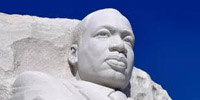 A close-up of the Stone of Hope at the Dr. Martin Luther King Memorialon the Mall in Washington, DC, carved by sculptor Lei Yixin
The Most Reverend Edward K. Braxton, Ph.D., S.T.D.
Bishop of Belleville, Illinois
Bishop Braxton is a leading voice commenting on the Racial Divide in the United States. In 2015, he issued his Pastoral Letter, “The Racial Divide in the United States: A Reflection for the World Day of Peace 2015.” In 2016, he published the companion Pastoral Letter, “The Catholic Church and the Black Lives Matter Movement: The Racial Divide Revisited.” This was followed in July 2016 by his Pastoral Statements, “Moral Leadership in Action: All Lives Really Do Matter” and “There Are No Minority Voters.” In January 2017, he published “We, Too, Sing America: The Catholic Church and the Museum of African American History and Culture.” At the invitation of Peter Cardinal Turkson, Prefect of the Vatican Congregation for the Promotion of Integral Human Development, the Bishop presided over a session of the Vatican’s international conference marking the 50th anniversary of Pope Paul VI’s encyclical Populorum Progressio (On the Development of Peoples) in April 2017.
In September 2017, he delivered the 10th Annual Dorothy Day Lecture at Purdue University. Later that month, the Bishop addressed the faculty, staff, and students of the National Catholic School of Social Service at The Catholic University of America on “Horizons of Possibilities: The Racial Divide in the United States: Old Wounds Reopened.” On February1, 2018, he delivered the address
“Racial Justice and Peace in Our Day” at Northwestern University’s Sheil Catholic Center. On February 21, 2018, he delivered the 12th Annual Thomas Merton Lecture at Bellarmine University in Louisville, Kentucky on “Thomas Merton’s ‘Letter to a White Liberal’ and Dr. Martin Luther King, Jr.’s ‘Letter from a Birmingham Jail’.”